
_800x800.jpg)
In the first of a short series of blogs to mark the publication of Thrive’s new ImpactEd report, Tom Preston looks at what the evaluation has to tell us about exclusions.
What's the true cost of an exclusion?
If you ask a leader in a large city high school you’re likely to get an answer quite different from that of a government policy maker.
Our new ImpactEd evaluation report has sought to answer this question by evaluating it from a range of perspectives.
The findings draw on one of the largest independent evaluations of a school wellbeing approach to date, combining a large-scale national comparative analysis of over 2,600 schools with a two-year mixed-methods evaluation following schools as the Thrive Approach became embedded in practice.
For the high school leader the question of the cost of an exclusion is answered in very human terms. Take Sammy (not his real name), for example. As a Year 7 in a large school in the south east, which was part of the evaluation, Sammy had a long record of behaviour issues and was subject to a fixed-term exclusion.
More than 130 defiance incidents were recorded against Sammy that year and he was removed from the classroom 112 times, with 67 internal exclusions.
Recognising his need for emotional wellbeing support, the school introduced him to the Thrive Approach, a programme designed to address social and emotional development.
Staff were trained to use non-confrontational language and focus on building positive relationships with students – an approach underpinned by an understanding that students show challenging behaviour because they find it hard to regulate themselves.
The human cost of not addressing Sammy’s behaviour issues would have been enormous. And when the cost of an exclusion is analysed on a system level the impact is even starker.
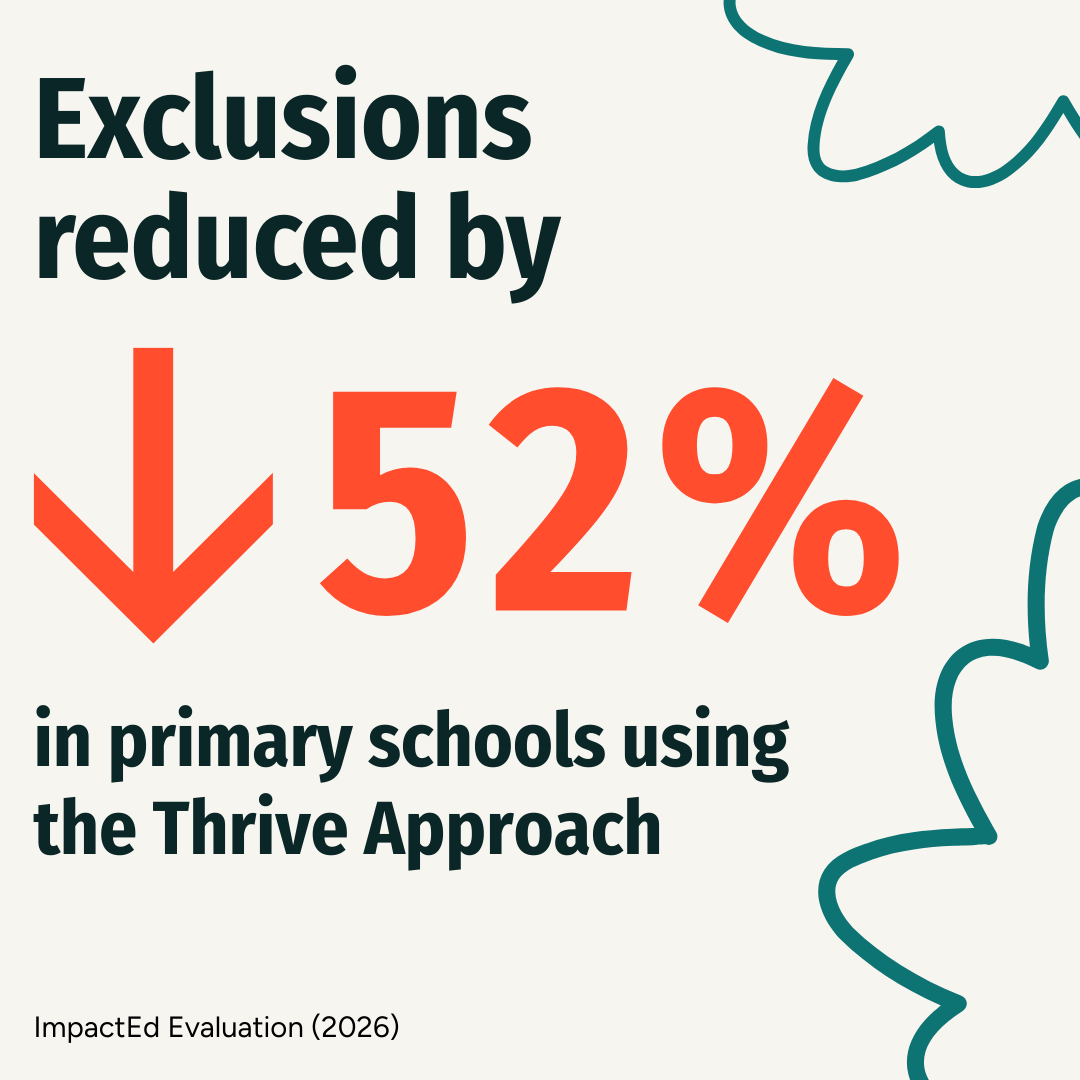
In the 2023/24 academic year, the national comparative analysis found that schools using Thrive recorded a 27% lower exclusion rate than the national average — equivalent to approximately four fewer exclusions per 1,000 pupils. Separately, the two-year mixed-methods evaluation found that exclusions reduced by 52% in primary schools and 35% in secondary schools over time.
National evidence indicates that Thrive schools experience approximately four fewer exclusions per 1,000 pupils per year compared with national averages (SEG, 2024). Existing economic research estimates that each permanent exclusion carries an average lifetime cost to the state of £170,000.
This equates to approximately £680,000 in avoided lifetime public costs per 1,000 pupils, £3.4 million for a multi-academy trust with 5,000 pupils, or £34 million for a local authority with 50,000 pupils.
These estimates represent long-term system benefits associated with avoided exclusions, rather than immediate, cashable savings.
Exclusions were substantially reduced in schools using the Thrive Approach, alongside positive patterns in engagement, attendance, and behaviour.
So, the question of what’s the true cost of exclusion has a range of inter-related answers, from the individual pupil and their family to their school, the local and national education system and, ultimately, society.
As a result of Thrive support Sammy’s overall behaviour dramatically improved, from 70% in Year 7 to 95% by Year 10, with a significant increase in positive behaviours and a huge reduction in negative incidents. He had turned his life around.
(1).png)
At Sammy’s school the use of the Thrive Approach resulted in overall student absence improving by more than 17% in 2023-24, with persistent absence down by 15%.
And for society, the impact on resources – on alternative provision, health, social care and justice services – will have been hugely reduced for each exclusion prevented.
Read the Thrive Evaluation Report
Pass it on
Small actions can lead to a big ripple effect. If you enjoyed this post or found it helpful, please consider supporting us in our mission to help every child and young person feel safe, supported and ready to learn by sharing it using the social media buttons below.
Want to join a like-minded community of senior leaders and classroom staff benefitting from insights and strategies to improve attendance, behaviour and attainment? Add your email address below. (It’s easy to unsubscribe).


(1)_680.png)