
Holy Trinity and St John’s CoE Primary School
Reduced behavioural incidents and well-supported staff
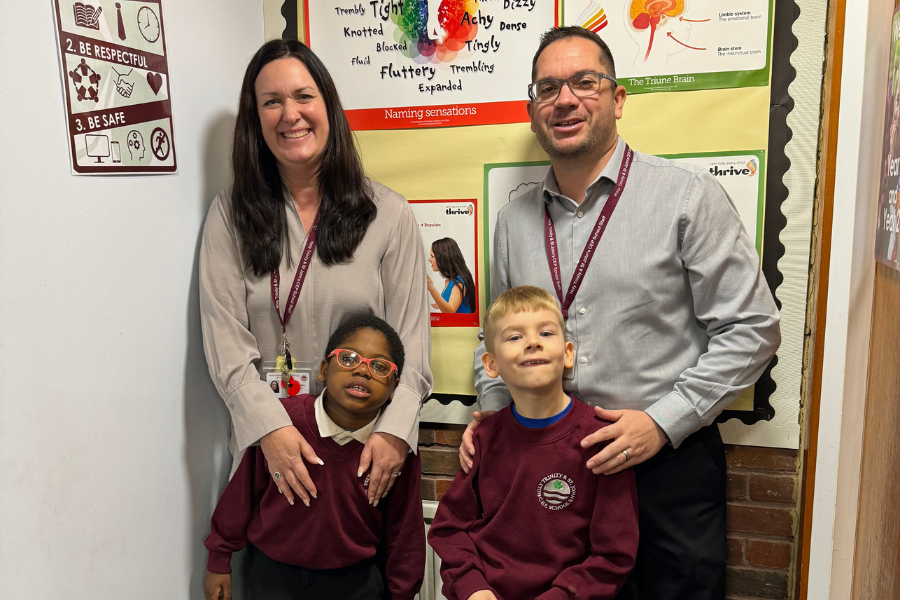
Holy Trinity and St John’s CoE Primary School introduced Thrive to help staff better understand children’s emotional needs and respond with consistency.
By embedding Thrive as part of a whole-school relational approach, the school has seen calmer classrooms, fewer behavioural incidents and staff who feel more confident supporting pupils when they are dysregulated.
The Context
Many pupils at Holy Trinity and St John’s have experienced significant interruptions in their lives, which can affect emotional regulation, behaviour and readiness to learn.
The school wanted an approach that would help staff understand children’s emotional needs more clearly and respond in a consistent, relational way.
- Location: Kent
- Diocese: Diocese of Canterbury
- Pupils: 402 (ages 4–11)
- FSM: 59.7%
- Thrive introduced: 2021
- Licensed Practitioners: 4
Why Thrive?
Thrive resonated with the school because it offered a relational approach that made sense for children and families from a wide range of backgrounds.
The idea of developmental interruptions was particularly powerful. It helped staff understand that when a child is struggling, their behaviour may relate to their emotional development rather than their chronological age.
For Headteacher Rob Garratt, Thrive felt robust and practical because it was grounded in brain development and neuroscience. It gave leaders, practitioners and wider staff a shared language for understanding emotional regulation and supporting pupils and families with confidence.
A SHARED APPROACH TO BEHAVIOUR
How Thrive was implemented
The school’s Thrive journey began when Assistant Headteacher and SENCO Donna McGiurk joined the school. It gained further momentum when Head of School and Inclusion Lead Sarah Roberts was appointed in September 2022.
- The leadership team completed Thrive’s Leading Emotionally Healthy Schools training, enabling them to develop a shared strategic understanding of how Thrive should be implemented.
- Two members of staff trained as Thrive Licensed Practitioners.
- Initial Thrive support focused on one-to-one and group work. More recently, pupils have been assessed across the whole school to identify who needs interventions or additional support.
- The school has developed six Thrive rooms, including two new cabins, and every classroom has a Thrive trolley with materials to support teaching and learning.
- All staff are being trained in the new relational approach to create a shared language and consistent response.

Our children weren’t ready to learn and now we have a tool to help them regulate themselves so that they are ready.
Sarah Roberts
Head of School and Inclusion Lead, Holy Trinity and St John’s CoE Primary School
CALMER CLASSROOMS, FEWER INCIDENTS
Impact on behaviour and regulation
Since implementing Thrive, the school is seeing fewer behavioural incidents and calmer, less disruptive classrooms.
Children who were previously at risk of exclusion because of high levels of dysregulation are now able to stay in class and take part in lessons.
For one group of Reception children who were struggling to stay emotionally regulated, teachers moved them into the Thrive room so Thrive Licensed Practitioners could support them. One child went from seven behavioural incidents in a term to one. Another went from six incidents to two, and a third went from five incidents to two.
Rob says children are now better able to verbalise how they feel and use safe spaces to regulate, creating a more positive atmosphere across the school.
Supporting the wider school community
Thrive has also had a positive impact on staff.
With a shared whole-school approach in place, staff now have the tools to understand why a child may be behaving in a certain way and respond consistently.
This has helped staff feel more confident and better equipped to support pupils’ wellbeing.
Rob explains the difference this has made: “Staff feel more confident. They know they are supported because we have a structured, whole school approach.”
The school is also extending this work into the wider community through Family Thrive. Its first Family Thrive course has already been completed, with more planned.
Teachers have shared Thrive plans with parents and carers where appropriate, helping families understand what support is being put in place and how they can use similar approaches at home.
WHAT OFSTED SAW
A calm and purposeful school
In its March 2023 inspection, Ofsted praised the school’s calm and purposeful approach to learning, as well as the strong systems in place to support pupils’ emotional wellbeing.
Inspectors noted that staff respond clearly and consistently when behaviour is more challenging, and that pupils are helped to manage their feelings and remain focused in lessons.
The school is now working towards Thrive’s Ambassador School programme and hopes to play an even greater role in the community, including exploring the idea of a wellbeing hub that could house a food bank and community resources.
Rob describes the work as a shared journey across staff, pupils and families: “We’re on a journey and we’re doing it together.”
Take the next step toward lasting change across your school or system.
Join 2,600+ schools and thousands of educators already
transforming practice with Thrive.