
Meridian High School
Calmer classrooms and happier teachers
Meridian High School serves a close-knit but disadvantaged community in Croydon. With above average numbers of pupils with special educational needs and disabilities, and two-thirds of pupils in receipt of pupil premium, the leadership team recognised that a traditional behaviour model based on rewards and sanctions was not meeting pupils’ needs.
By embedding Thrive, the school has created a calmer atmosphere, improved staff confidence and helped more students engage with learning.
The Context
Some of Meridian High School’s pupils have complex needs, and staff were finding that a conventional approach to behaviour was not having the impact they wanted.
Rewards and sanctions were not enough. The leadership team wanted an approach that would help staff understand what was behind behaviour, respond consistently and support students to return to learning.
- Location: London
- Trust: GLF Schools
- Pupils: 537 (ages 11-18
- FSM: 65.2%
- Thrive introduced: 2018
- Licensed Practitioners: 3
Why Thrive?
Thrive gave Meridian a more relational way to understand and respond to behaviour.
Instead of focusing only on what students were doing, staff could begin to understand the emotional need a student might be communicating. This helped shift the focus from managing behaviour to removing barriers to learning.
Jayne Curd, Senior Leader for Behaviour, describes it as a change in how adults relate to students: “When we change the way we are with them, it changes the response we get from them.”
For the team, Thrive offered a way to support high expectations while helping pupils feel safe, understood and ready to learn.
A RELATIONAL APPROACH TO BEHAVIOUR
How Thrive was implemented
Meridian began its journey by training two Thrive Licensed Practitioners.
- A colleague within GLF Schools recommended Thrive as an effective solution.
- Thrive was introduced to move beyond a behaviour model based mainly on rewards and sanctions.
- Staff used Thrive to better understand the emotional need a student might be communicating.
- Thrive reports are shared regularly with all staff, highlighting students who are doing well and those who may need additional support. The reports include strategies for responding to difficult situations and helping students find solutions.
- Thrive reminders are visible across the school, including posters in classrooms, laminated strategies on teachers’ desks and Thrive-based messages on TV monitors.
- Thrive is used in PSHE and referenced across the wider curriculum.
- Thrive-Online helps the school evidence pupils’ needs and monitor progress against age-appropriate development goals.

You hear some of our children say things like ‘do you want to borrow my adult thinking brain?’ as they learn about what is going on in their brains. We see them able to take on more responsibility, to have ownership over their actions and to make more positive choices.
Jayne Curd
Senior Leader for Behaviour, Meridian High School
CONSISTENT COMMUNICATION ACROSS SCHOOL
Keeping Thrive visible
Communication has played a key role in embedding Thrive across Meridian.
A regular Thrive report is shared with all staff, highlighting which students are doing well and who may need additional support. It also provides strategies for responding to difficult situations, helping staff and students focus on finding a solution together.
Thrive reminders are also visible around the school. Every classroom has a poster showing Thrive’s Vital Relational Functions, and teachers have laminated strategies on their desks to support their responses in difficult moments. TV monitors around the school display Thrive-based messages about communication and relationships.
Jayne says this has helped keep Thrive visible across the school, keeping everyone informed and helping students find their own solutions to problems.
Creating calmer classrooms
Meridian has developed a social, emotional and mental health provision that includes a Thrive room and a sensory room.
The school has also introduced a Thrive breakfast club, helping students start the day feeling connected and safe. This gives staff an opportunity to notice which students may need extra support before lessons begin.
Across the school, staff use Thrive to identify barriers to learning and respond to the emotional need a student is communicating.
As a result, Meridian has seen more pupils engaging with learning and more students seeking out trusted adults when they need support.
SUPPORTING HIGH EXPECTATIONS
Helping students take responsibility
Thrive has helped Meridian maintain high expectations while giving students the support they need to meet them.
The Approach is used in PSHE and referenced across the wider curriculum. In science, for example, pupils make models of the brain to help them understand emotions and how they respond to different situations.
Students are learning to take more responsibility, understand their reactions and make more positive choices.
Jayne says the school is clear that support and expectations go together: “Children are expected to meet the expectations we have for them and they are individually supported to help them in this.”
HAPPIER STAFF AND STUDENTS READY TO LEARN
Impact on staff and students
Meridian’s Thrive work has changed the atmosphere across the school.
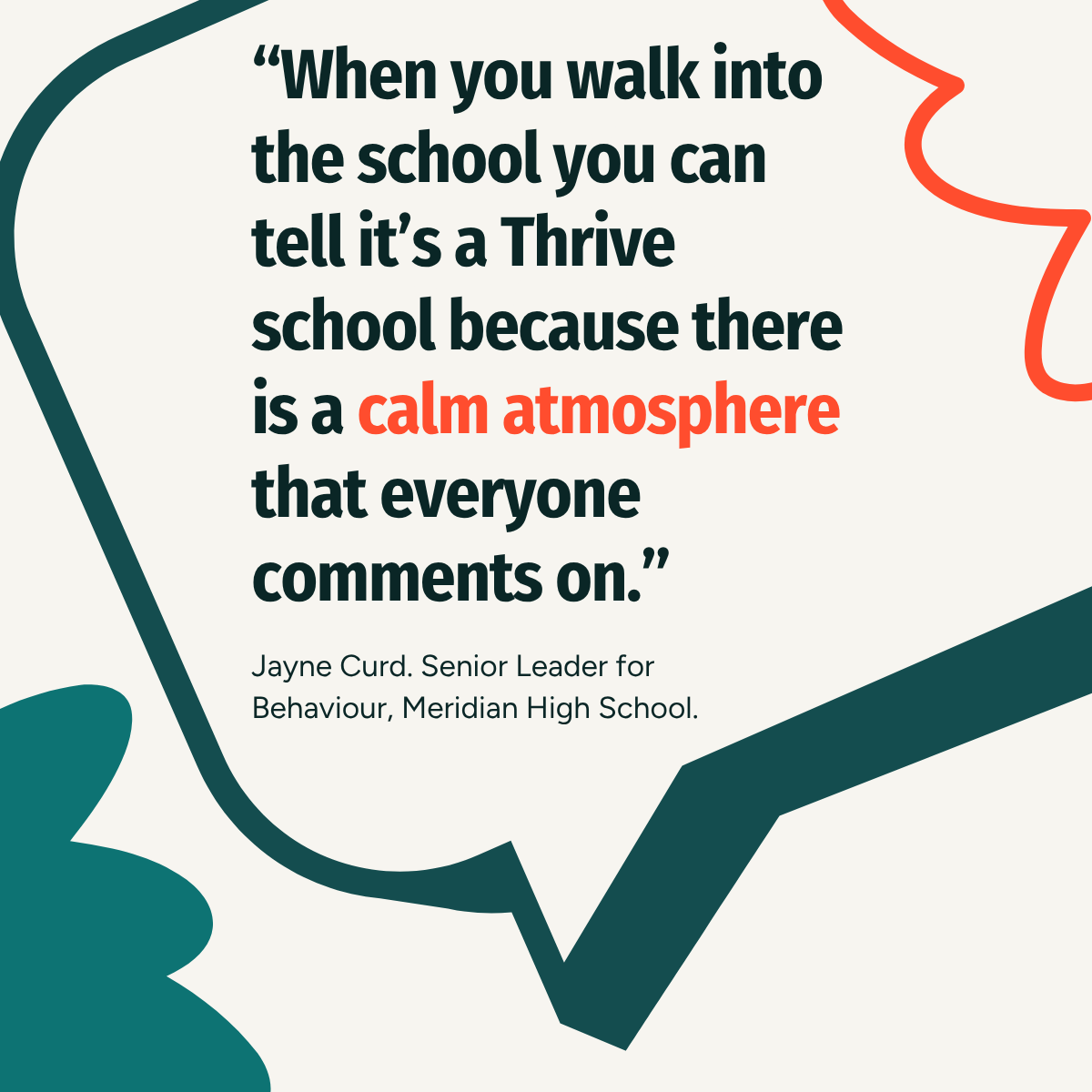
Visitors often comment on the calm environment, and staff are seeing the benefits of students being more regulated and ready to learn.
Having Thrive embedded also helped the school respond to the impact of the Covid-19 pandemic. When students returned to school, many had regressed socially and emotionally. Thrive gave staff a framework to identify and meet those needs.
Teachers want to teach. They don’t want to have to manage pupils that are disrupting a lesson. If our students are calm and ready to learn, we know our staff will be happier and more fulfilled too.
Jayne Curd
Senior Leader for Behaviour, Meridian High School
THRIVE SCHOOL OF EXCELLENCE
Recognition
Meridian High School has been named a Thrive School of Excellence, the highest level of achievement in Thrive’s Ambassador School scheme. The award recognises settings showcasing outstanding mental health and wellbeing support.
Headteacher Amy Anderson says the school’s approach is rooted in the link between emotional wellbeing and learning: “If children’s emotional wellbeing is nurtured then they will be able to learn effectively, and the rest will follow.”
Pupils celebrated the achievement by welcoming visitors including Lord O’Shaughnessy, the Mayor of Croydon and representatives from the local authority.
Visitors were given a tour of the school by Meridian’s Thrive Ambassadors. There is one Ambassador per year group, and pupils apply for the role by explaining why they would like to get involved.
One Thrive Ambassador explained how the role helps them support others: “Thrive has helped me to manage my emotions. I can now regulate myself and use the strategies I have learned to help other students.”
Take the next step toward lasting change across your school or system.
Join 2,600+ schools and thousands of educators already
transforming practice with Thrive.