
When practitioners hear the term enabling environment, it's easy to think about resources, displays and room layout. While these things matter, the most effective enabling environments in the early years start somewhere else: with understanding how children experience the world around them.
In the Early Years Foundation Stage (EYFS), enabling environments are one of the four guiding principles that support children's learning and development. An enabling environment helps children feel safe, valued, understood and ready to engage with the world around them. It creates the conditions children need to learn, build relationships and thrive.
As children's needs become increasingly diverse, creating environments that support emotional wellbeing and development has never been more important.
What is an enabling environment in the EYFS?
An enabling environment is a space, culture and approach that supports every child to learn and develop.
In practice, this means considering:- The physical environment
- Relationships with adults and peers
- Daily routines and transitions
- Opportunities for play and exploration
- Children's emotional wellbeing and sense of belonging
- The experiences and interactions children encounter each day
Why are enabling environments important in the early years?
Many practitioners are seeing more children arrive with emerging needs, differences in communication, or difficulties with emotional regulation. The instinct can be to focus on behaviour. Yet often, behaviour is simply information.
A child who struggles during carpet time, transitions or mealtimes may not be choosing to challenge expectations. They may be responding to an environment that feels overwhelming, unpredictable or difficult to navigate.
That's why an enabling environment in early years practice is about more than physical space. It's about creating conditions that help children feel regulated enough to learn, play and connect.
When children feel overwhelmed, anxious or dysregulated, their brains are focused on managing those feelings rather than engaging in learning. By creating environments that reduce unnecessary stress and increase feelings of safety and belonging, practitioners can help children access learning more successfully.
This is particularly important because research and experience tell us that children's environments influence far more than their academic development. They shape how children experience relationships, build confidence, communicate with others and develop the skills needed to navigate the world around them.
An effective enabling environment supports:
- Emotional development: Children develop confidence, resilience and self-esteem when they feel understood and valued.
- Communication and language: Safe, nurturing environments help children develop language and build meaningful relationships with adults and peers.
- Social development: Children learn to cooperate, negotiate and manage relationships through positive interactions and opportunities for shared play.
- Self-regulation: Predictable routines and responsive adults help children understand and manage their emotions over time.
- Learning and exploration: When children feel emotionally secure, they are more willing to take risks, explore new ideas and engage deeply in learning.
The environment is more than the room
When discussing early years environments, it's common to focus on resources and organisation. While these elements matter, they are only one part of the picture.
A truly enabling environment includes three interconnected areas:
The physical environment
This includes:
- Indoor learning spaces
- Outdoor provision
- Resources and equipment
- Layout and accessibility
- Noise levels and sensory demands
The physical environment should invite curiosity while remaining calm, predictable and inclusive.
The emotional environment
Children need to experience:
- Warm, trusting relationships
- Consistent boundaries
- Emotional safety
- A sense of belonging
- Opportunities to express feelings
For many children, emotional safety is the foundation that makes learning possible.
The relational environment
The way adults interact with children has a profound impact on development.
Responsive practitioners:- Tune into children's needs
- Build secure relationships
- Notice emotional cues
- Support co-regulation
- Create moments of connection throughout the day
Often, it is these interactions that transform a space into a truly enabling environment.
Creating enabling environments in practice
The good news is that creating an enabling environment doesn't require a complete redesign of your setting. Often, the most effective changes are the smallest.
Simple adjustments can help reduce unnecessary stress and increase children's sense of predictability and belonging:
- Reviewing transitions that regularly lead to distress
- Reducing unnecessary noise and visual distraction
- Creating calm spaces where children can regulate with adult support
- Offering consistency while remaining flexible to children's needs
- Developing a shared team understanding that behaviour communicates need
These approaches benefit all children, not only those with identified SEND.
As the EYFS reminds us, every child is unique. Enabling environments help us respond to those differences with curiosity rather than assumptions.
Viewing behaviour differently
One of the key messages from Thrive's recent webinar on inclusive practice was simple: The environment is the intervention.
Children don't all experience the same environment in the same way. What feels manageable for one child may feel overwhelming for another.
Think about a typical transition before lunch. Children may be moving indoors, tidying away, listening to instructions, responding to noise levels increasing and anticipating a change in routine, all at the same time.
For some children, those demands build up quickly.
When we look at behaviour through this lens, we move away from asking:
"How do we manage this behaviour?"
And instead ask:
"What might this child be experiencing right now?"
This approach helps practitioners create environments that respond to children's needs rather than simply reacting to behaviour.
Start with one moment
Creating truly inclusive enabling environments isn't about having all the answers.
It's about noticing the moments that feel difficult for children, becoming curious about why, and making small, thoughtful changes that help them feel safe enough to engage and learn. Because when children feel understood, everything else becomes possible.
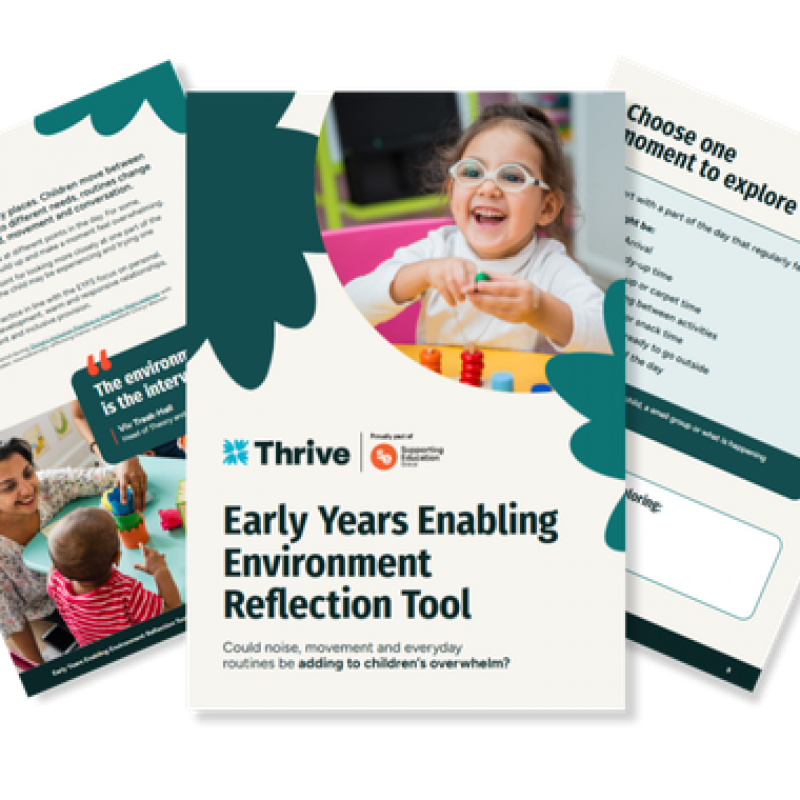
Download our free early years enabling environment audit and reflection tool
Creating an enabling environment is an ongoing process of observation, reflection and adaptation. That's why we've developed a free Early Years Enabling Environment Reflection Tool to help practitioners and leadership teams:- Reflect on moments that regularly feel difficult for children
- Explore what children may be experiencing beneath the behaviour
- Consider how the environment might be contributing to overwhelm
- Identify one manageable change to trial as a team
Rather than focusing on large-scale changes, the tool encourages teams to identify one area for development and explore how small adjustments could improve children's wellbeing, regulation and engagement.
Download the free reflection tool and start creating an environment where every child feels safe, supported and ready to thrive.
(1)_680.png)